Quarter Fever: How 1980s Arcade Characters Conquered Pop Culture
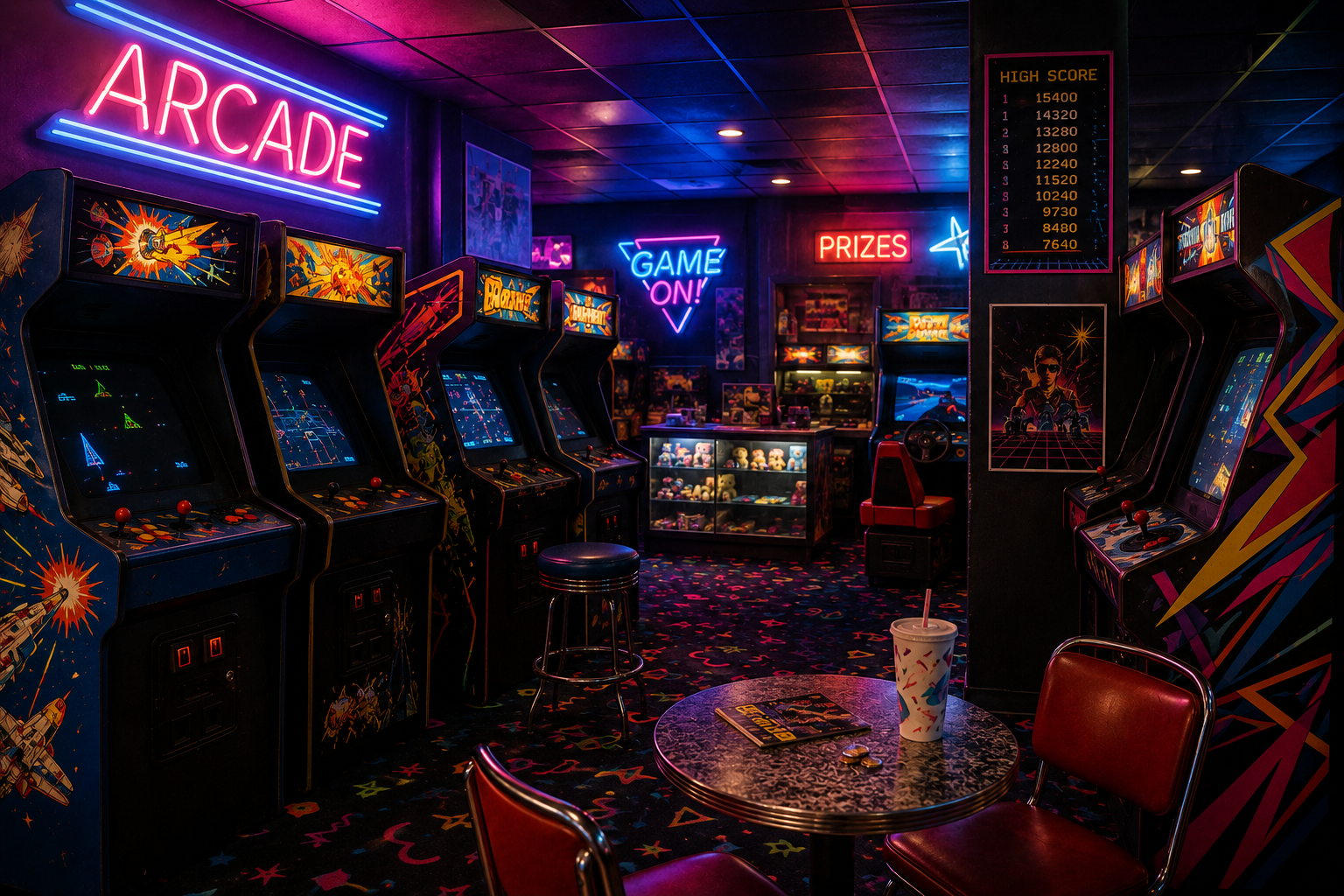
There was a time when the most exciting place in America was a dimly lit, windowless room filled with a deafening symphony of electronic beeps, boops, laser blasts, and synthetic explosions.
In the early 1980s, the video game arcade wasn't just a place to hang out—it was the epicenter of youth culture. Driven by a rapidly evolving tech boom, the arcade industry exploded into a multi-billion-dollar phenomenon. Suddenly, pixels became personalities. For the first time in history, video game characters broke free from their glowing CRT monitors and staged a full-scale coup of American pop culture, conquering prime-time television, toy aisles, and even the breakfast table.
Here is how a bunch of pixelated shapes triggered a marketing frenzy that changed the entertainment industry forever.
The Golden Age of the Arcade
Before home consoles like the Nintendo Entertainment System arrived to dominate the mid-to-late '80s, you had to leave the house and hunt for a coin-op machine if you wanted a gaming fix. Between 1980 and 1983, arcades experienced a literal "Golden Age."
It started with the mechanical dread of Space Invaders and the vector-graphic thrill of Asteroids, but the true cultural shift happened when games moved away from faceless spaceships and introduced characters.
When Namco released Pac-Man in 1980, it blew the doors wide open. It wasn't about shooting military targets; it was a whimsical, color-coded maze game with a protagonist who had a clear motivation (eating) and a quirky cast of ghostly antagonists (Blinky, Pinky, Inky, and Clyde). It appealed across demographics, drawing in millions of female players who had previously ignored the sci-fi shooting galleries.
By 1982, arcades were raking in more money annually than the US pop music industry and Hollywood box offices combined. Quarters were the de facto currency of American teenagers, and the characters they were feeding those quarters to were about to become household names.
Saturday Morning Pixel Toons
Once Hollywood executives realized that kids were hypnotized by these electronic sprites, they rushed to port them over to the ultimate kingdom of 1980s childhood: Saturday morning cartoons.
In 1982, animation giant Hanna-Barbera launched the Pac-Man animated series* on ABC. It was an overnight ratings juggernaut, attracting over 20 million viewers. The show had to invent an entire universe out of a game that was originally just about a circle eating dots. Pac-Man was given a family (Pepper Pac-Man and Baby Pac-Man), a dog (Chomp-Chomp), and lived in "Pac-Land" under the constant threat of Mezmaron and his Ghost Monsters.
Seeing Pac-Man's success, CBS fired back in 1983 with Saturday Supercade**. Produced by Ruby-Spears, this anthology show was a revolving door of arcade legends. It featured animated shorts starring Donkey Kong (where Mario and Pauline chased the escaped ape), Donkey Kong Jr., Frogger, and Q*bert.
Suddenly, games that lacked any real plot were given voices, theme songs, and complex backstories, cementing them into the cultural consciousness alongside classics like Looney Tunes or Scooby-Diew.
The Ultimate Honor: Arcade Breakfast Cereals
In the 1980s, you knew a franchise had truly "arrived" when a cereal company shaped a high-fructose corn puff after it. The grocery store cereal aisle became the secondary battlefield for arcade supremacy.
General Mills kicked things off with Pac-Man Cereal in 1983. Advertised as a "crunchy, sweetened corn cereal with marshmallow ghosts," it was essentially Lucky Charms with a video game coat of paint. The commercial jingle famously proclaimed it was "delicious, nutritious, and arcade-shaped!" It was a massive hit, eventually spinning off a Ms. Pac-Man version as well.
Not to be outdone, Ralston Purina (a company that ironically also made pet food) jumped into the ring with Donkey Kong Cereal in 1982. The cereal pieces were shaped like miniature plastic barrels, mimicking the hazards Mario had to jump over in the arcade. Ralston followed this up with Donkey Kong Junior Cereal (sweetened corn barrels and fruit-flavored bananas).
Pouring milk over edible arcade characters while watching those same characters on a CRT television was the definitive Saturday morning ritual for an entire generation.
The Pac-Man Fever Legacy
The arcade takeover extended far beyond TV and breakfast. There was Pac-Man Fever, a pop song by Buckner & Garcia that broke into the Billboard Top 10. There were Pac-Man board games, lunchboxes, pajamas, and underwear.
While the Great Video Game Crash of 1983 temporarily cooled off the industry and closed down thousands of local arcades, the character-first marketing blueprint established during this era never went away. The massive multi-media dominance we see today with franchises like Sonic the Hedgehog, Pokémon, and Nintendo's cinematic universe all started because a little yellow circle ate a power pellet in 1980 and decided to take over the world.
Comments (0)
No comments yet. Be the first to share your thoughts.
Sign in in your browser to leave a comment.